 PartDorinUpload RFQRFQ
Geely Coolray engine cooling parts: radiator, fan, pump and thermostat guide
Build a Coolray cooling-system parts request from a confirmed workshop diagnosis, exact vehicle configuration and interface evidence.
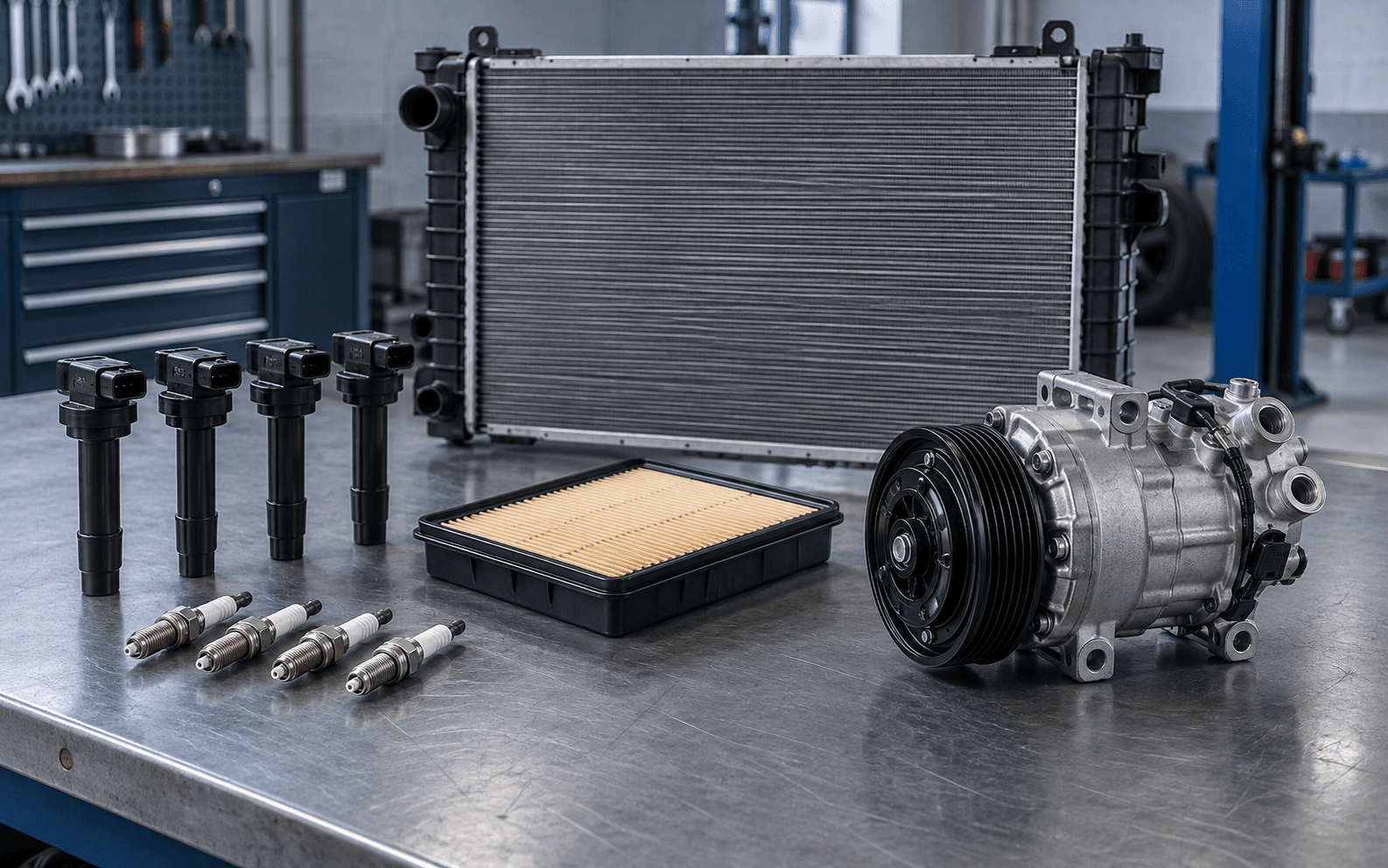
To source Geely Coolray engine cooling parts, provide the VIN, generation, market, build date, engine, transmission, OE number and component photos. Specify whether the repair needs a radiator, fan module, water pump, thermostat housing, hose or expansion tank, then verify ports, mounts, connectors and included seals.
Short answer: match the confirmed component to the exact Coolray configuration
Geely Coolray engine cooling parts should be sourced after a qualified workshop identifies the required repair. Provide the VIN, generation, original market, production date, engine, transmission, complete OE reference and photographs of the component’s ports, mounts, connectors and labels. Specify whether the request is for a radiator, fan module, water pump, thermostat housing, hose, expansion tank or sensor.
An overheating message, coolant loss, fan noise or fluctuating temperature is a starting symptom, not a product specification. Several system conditions can produce similar observations. A supplier should match the workshop-confirmed component and evidence; it should not diagnose the vehicle remotely or sell a generic cooling kit.
This guide helps importers, distributors and service networks build a controlled RFQ. It does not replace Geely owner/service information, hot-system safety procedures, pressure testing, coolant specification or qualified filling and bleeding.
Why generation, market and engine matter for Coolray parts
Geely sells Coolray across multiple markets and production periods. The official Geely New Coolray page describes a current global configuration and states that actual specifications can depend on market. That is useful context, but a global product page cannot prove a radiator, pump or thermostat application for every vehicle.
Record the exact market name, VIN, physical build date, engine code/configuration and transmission. If the vehicle is known under a related name in another market, store that name as a search alias rather than merging the technical application automatically. A shared architecture or engine family does not make every cooling component interchangeable.
The Geely Coolray parts page provides a model-level sourcing entry. Use the export vehicle variant guide to control domestic/export naming, production breaks and equipment differences.

Cooling-system symptoms require professional diagnosis
Temperature warning or overheating
A workshop may examine coolant quantity, external leakage, airflow, fan command/operation, pump circulation, thermostat behavior, radiator condition, cap/tank function, sensors, engine condition and the circumstances under which the warning appeared. The exact diagnostic path belongs to qualified personnel using authoritative information.
Do not continue running a vehicle to “see if the warning returns” based on an article. Follow the vehicle’s warning and recovery guidance. The purchasing team should receive a confirmed component list after the vehicle is made safe.
Coolant loss or visible residue
Fluid can escape from a hose, connection, tank, radiator, pump, housing or another point and travel before it becomes visible. A photograph of residue does not prove the source. Ask the workshop to identify the leak and list required seals, clamps and related parts.
Fan noise or fan not operating
Noise can involve the blade, motor, shroud, mounting or foreign contact. Non-operation can involve power, control, wiring, sensor input or the fan module. The supplier cannot choose a fan motor from the phrase “fan fault.” Provide the confirmed assembly and electrical/physical references.
Slow warm-up or unstable temperature
A thermostat may be one possibility, but the symptom does not authorize replacement. The workshop should diagnose the system. If a thermostat or housing is confirmed, the RFQ should identify its exact configuration, connector/sensor and included seal.
The evidence packet for Coolray engine cooling parts
Use one row per requested product and include:
- Complete VIN, exact generation/market name and build date.
- Engine and transmission identification.
- Original market and destination country.
- Complete OE number, suffix and source.
- Confirmed component and installed position.
- Full part, label, port, mount and connector photographs.
- Controlled dimensions or drawing when fitment depends on them.
- Included seals, clamps, caps, brackets, motor or controller.
- Quantity, packaging and inspection requirements.
- Open technical questions and workshop diagnosis reference.
The VIN and OE number should reinforce each other. If they disagree, hold the line and investigate the number source, production break and interfaces. The Chinese car parts VIN and OE guide provides the full workflow.
Radiator matching checklist
Compare the radiator by vehicle/engine condition, core and total dimensions, tank construction, inlet and outlet positions and diameters, mounting points, drain and sensor provisions, fan/shroud interfaces, and any transmission or auxiliary-cooler connections. State whether the quote is radiator-only or a front cooling module.
A matching width and height are not enough. Port angle, mounting tabs and cooler connections can decide whether a part installs. Ask the supplier to provide a drawing or controlled dimensional record, confirmed production range and exclusions.
If a pressure or leakage test is required, define the method, medium, pressure, duration, sample size and acceptance criterion with technically competent personnel. Avoid inserting a generic value into an RFQ. The correct control should come from the approved product specification.
For shipment inspection, check product identity, fins, tubes/tanks, mounts, ports, caps, visible contamination, accessories and packing. Use internal supports that protect the core and necks without loading the fins.
Cooling fan and shroud sourcing
Define whether the requested item is a blade, motor, complete fan-and-shroud assembly, controller/resistor or wiring component. Record fan dimensions, rotation/airflow configuration, shroud mounts, connector, wire routing, controller identity and included hardware.
A connector match does not establish control compatibility. For electronically controlled fans, hardware and electrical evidence should be reviewed together. Ask the supplier to state its function-test method and application condition. Do not describe a simple spin or continuity check as complete vehicle validation.
Packing should immobilize the assembly without distorting the shroud or blade. Protect connectors and leads. During inspection, verify label identity, connector, mounts and approved free condition; do not energize an unknown product with an improvised power source.
Water pump sourcing
Identify whether the vehicle uses the requested mechanical engine pump, an electric auxiliary pump or another circuit component. Record engine, OE reference, drive interface or electrical connector, housing, ports, mounts, pulley/flange and supplied gasket or seal.
For a mechanical pump, a similar housing can conceal a different impeller or flange. For an electric pump, a similar connector can conceal different control or performance. Use approved product data and category-appropriate testing rather than appearance.
The quotation should state pump-only versus housing/module scope. List gaskets, seals, pulley, thermostat or hardware. At shipment inspection, protect sealing surfaces, verify clean capped ports, check identity and accessories, and review lot test records required by the purchase order.
Thermostat and thermostat-housing matching
Distinguish a thermostat element from a complete housing, sensor-equipped assembly or electronically controlled unit. Record engine, production date, OE reference, housing shape, ports, connector/sensor, seal and verified operating specification from authoritative data.
Do not use one assumed opening temperature for every Coolray configuration. If the temperature is part of the product specification, require a source and test method. A supplier listing copied across several models should remain a candidate until vehicle and interface evidence is checked.
Functional inspection should use a controlled and safe method suitable for the design. Do not recommend placing an electronic thermostat in boiling water or using an improvised test. Qualified workshop and supplier procedures take priority.
Hoses, pipes, clamps and quick connectors
Hoses should be identified by full molded route, branch points, inside diameters, quick-connect ends, protective sleeves, clamps and sensor/bleed features. A universal hose cut to length is not equivalent to a molded assembly unless the vehicle and repair procedure explicitly support it.
Photograph the removed hose in its installed context before removal where practical, then laid flat without forcing it. Mark the vehicle end and component end. For quick connectors, capture locking and sealing features. List whether O-rings, clips and clamps are included.
Rigid pipes require bend geometry, mounts, flanges, seals, finish and corrosion protection. Long pieces need internal carton support. At inspection, check for distortion, damaged beads or connectors and missing accessory bags.
Expansion tank, cap and level sensor
For an expansion tank, compare mounts, connections, shape/clearance, level markings, sensor provision and cap scope. Do not approve by approximate volume. A tank can fit the available space but route hoses or sensor differently.
Treat the cap as a functional component with an exact approved reference. Do not state a pressure rating from memory or transfer it from another model. If the cap is included with the tank, put this on the quotation; if not, make the exclusion visible.
Tank interiors and openings should remain clean. Pack caps and sensors so they cannot crack the tank. Inspection photographs should show all necks, mounts, label and included items.
Share the reference, vehicle application and target quantity so the technical and packing questions can be reviewed against your actual order.
Upload Your RFQSensors, relays and electrically controlled valves
Record the complete reference, installed location, mount/thread, seal, connector keying, terminal count and system function. A Coolray can have multiple temperature or pressure inputs; “coolant sensor” is not a complete identity.
Diagnostic trouble data belongs to the workshop process and does not automatically prove a sensor has failed. Once the component is confirmed, the supplier should state its test method. For an output sensor, a continuity check may be insufficient; require product-appropriate evidence.
Software-dependent modules or valves may require coding, adaptation or a defined installation process. Confirm this through authoritative service information. A parts listing should not promise plug-and-play operation from hardware appearance.
Coolant specification and hot-system safety
Never open a hot pressurized cooling system. Geely owner information for the exact market should control warnings, coolant type and procedure. An official regional Geely owner manual illustrates manufacturer warnings about allowing the system to cool before opening a pressure cap; the actual Coolray manual for the VIN remains the required reference.
Do not mix coolant products based on color. Use the specification and procedure applicable to the vehicle and market. The distributor should avoid republishing one regional fluid quantity or interval as universal.
After component replacement, qualified personnel should fill, bleed, inspect and test the system under the proper procedure. Air trapped in a system can affect operation, but this sourcing guide does not provide a bleeding sequence.
Distinguish engine cooling from air conditioning
Customers sometimes call weak cabin A/C a “cooling problem.” Separate engine cooling from refrigerant and cabin-airflow systems. Radiator, condenser, compressor, evaporator, blower and heater components have different functions and RFQ fields.
For an A/C component, identify the refrigerant/system data from authoritative information, ports, mounts, connector and included seals. Refrigerant recovery and charging require trained personnel and compliance with local rules. The U.S. EPA motor-vehicle A/C guidance is one official example; buyers must follow requirements in the destination market.
If a front module includes radiator, condenser, intercooler, fan or shroud, list each item. Do not compare a radiator-only price with a complete cooling-pack offer.
A seven-step Coolray cooling-parts workflow
Step 1: obtain the confirmed repair list
Separate symptom, diagnosis and replacement items. Ask the workshop to name related seals, clamps and required follow-up work.
Step 2: validate the Coolray identity
Confirm VIN, generation, market, build date, engine and transmission.
Step 3: capture the OE reference
Preserve the full number and source. Distinguish service number from casting, serial or supplier codes.
Step 4: define the product and assembly boundary
Name the component and list every included housing, motor, controller, gasket, seal, cap or bracket.
Step 5: compare ports, mounts and controls
Use controlled drawings, samples and product-specific dimensions. Keep unresolved differences visible.
Step 6: approve sample, test and packing
Record the supplier number, vehicle condition, inspection/test method, label and protective packaging.
Step 7: inspect the shipment
Verify identity, visible condition, clean caps, connectors, accessories, quantity and carton/pallet condition.
Factory-testing questions for cooling parts
Ask the supplier to name the tested characteristic, method, equipment, sample size and acceptance criterion. Relevant controls may include dimensions, port/mount verification, visual cleanliness, a defined leakage test, electrical function or identity and packing. The exact method depends on the product.
Fitment and manufacturing quality are separate. A radiator may be leak-tight but have the wrong port. A fan may operate but use the wrong shroud or controller. Build both application evidence and product controls into the approval plan.
For a new supplier or new line, the automotive supplier audit checklist helps trace one order from RFQ and sample approval through production and shipment release.
Copy-ready Coolray cooling-system RFQ
- Buyer SKU / line:
- VIN / generation / market / build date:
- Engine / transmission:
- Confirmed workshop diagnosis and required component:
- OE reference and source:
- Ports, mounts, connectors and key dimensions:
- Required assembly content and accessories:
- Quantity / selling unit / packaging:
- Destination country and required evidence:
- Sample or drawing requirement:
- Open technical questions:
Ask the supplier to return its number, confirmed application, exclusions, included content, drawing/sample availability, test basis, MOQ, lead-time assumptions and packing. Use the automotive parts RFQ template for multi-SKU enquiries.
Shipment inspection and export packing
Inspect selected cartons against purchase-order lines. Verify buyer SKU, supplier number, OE cross-reference, vehicle/engine condition, product marking, ports, mounts, connector and accessory content. Check the defined dimensions or records in the approved plan rather than collecting irrelevant measurements.
Radiators need fin, neck and core support; pumps and thermostats need protected sealing surfaces; fans need rigid shroud/blade protection; hoses and pipes need shape retention. Keep openings capped and clean. Ensure master cartons and pallets withstand the planned route and handling.
Photograph the product, inner label and master carton together. Reconcile quantities with the packing list before dispatch. The pre-shipment inspection guide provides a broader release checklist.
Common purchasing errors
- Ordering from Coolray model name and engine displacement only.
- Omitting generation, market, build date or transmission.
- Treating overheating as proof of radiator or thermostat failure.
- Approving a radiator by width and height without ports and mounts.
- Comparing fan motor, fan module and complete cooling-pack prices as equivalent.
- Omitting housing, gasket, cap, clamps or controller from scope.
- Matching an electric part by connector alone.
- Copying coolant type, quantity or interval from another market.
- Accepting “pressure tested” without method and criterion.
- Shipping uncapped or poorly supported cooling components.
FAQ
Which details are needed to buy a Geely Coolray radiator?
Provide VIN, generation, original market, build date, engine, transmission, OE reference, core and overall dimensions, port and mount photos, cooler/fan connections and required assembly scope. A model name and size alone are insufficient.
Does a high temperature warning mean the thermostat is faulty?
No. Several cooling, airflow, control or engine conditions can produce a warning. Follow vehicle safety guidance and have a qualified technician diagnose the system before preparing the parts order.
Can Coolray cooling parts cross-reference to related Geely models?
Only where controlled part-specific evidence supports the relationship. A shared platform or engine family is not proof. Compare VIN/market condition, OE references, production date, ports, mounts, controls and assembly content.
Should a radiator include the fan and shroud?
Not automatically. Suppliers may quote radiator-only, radiator with shroud, or a larger module. State the required boundary and compare offers by included content.
What should be photographed during shipment inspection?
Photograph product marking, overall condition, ports and caps, mounts, connector, included accessories, inner label, master carton and pallet condition so the selected unit remains traceable to the order line.
Conclusion: source the diagnosed component, not the symptom
Reliable Geely Coolray engine cooling parts sourcing connects a qualified diagnosis with VIN, generation, engine, OE evidence and product-specific interfaces. Define the exact assembly, approve ports, mounts and controls, and protect cleanliness and identity through shipment inspection.
PartDorin is an independent B2B sourcing and manufacturing-support company and is not affiliated with or authorized by Geely. To prepare a Coolray cooling-system order, send your VIN, workshop list, OE references, photos and quantities. We can organize confirmed lines and open fitment questions for a controlled quotation.
Discuss the requirements for your next order.
Send your part references, vehicle applications, target quantities, destination market and any inspection or packing priorities. PartDorin will review the information needed for a focused quotation.
Send Your Requirements