 PartDorinUpload RFQRFQ
Chery TIGGO 8 cooling system parts: radiator, fan, pump and hose sourcing
Use a workshop diagnosis and a complete TIGGO 8 vehicle record to identify the correct cooling component, interfaces and assembly scope.
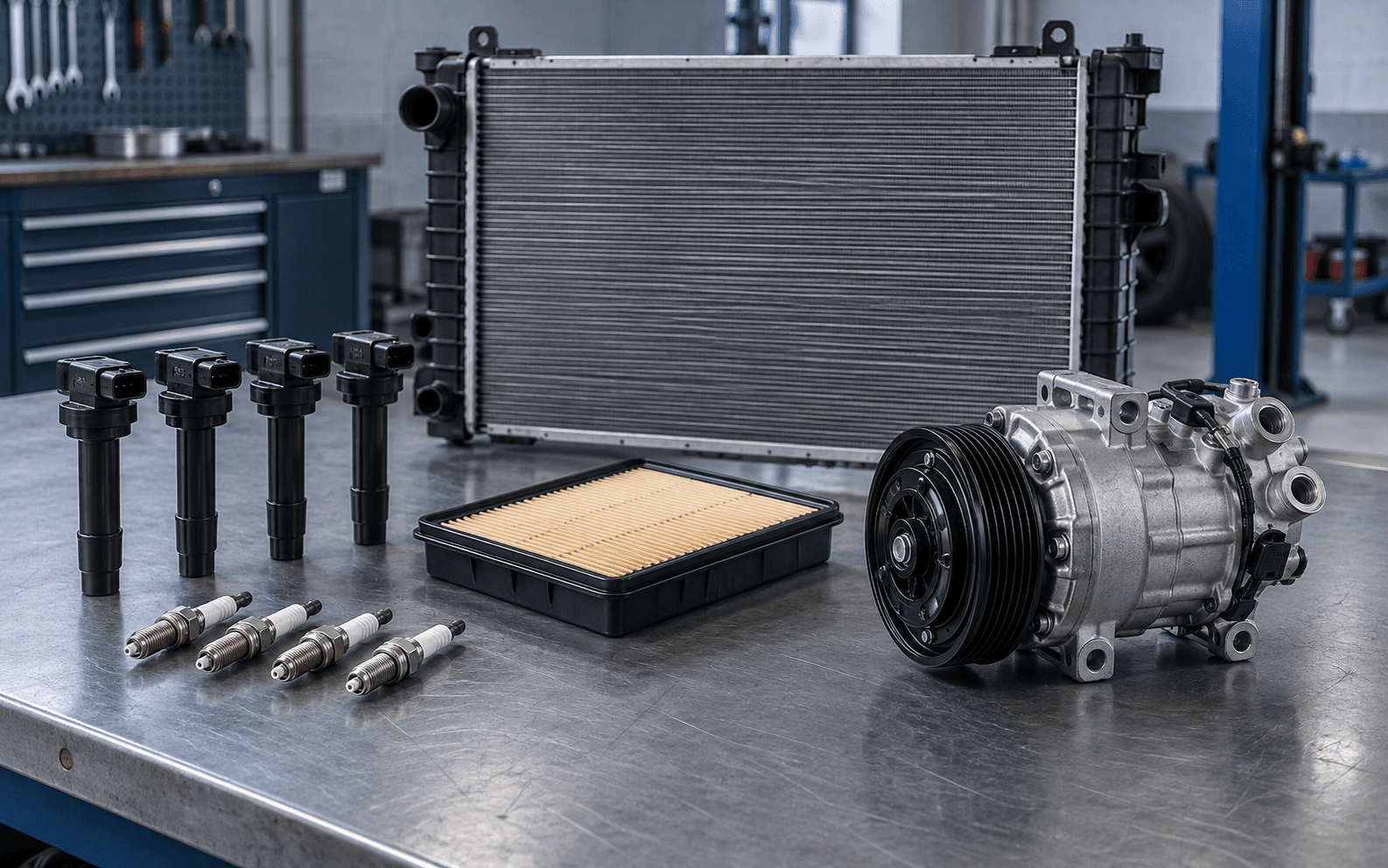
To source Chery TIGGO 8 cooling system parts, send the VIN, exact regional model, build date, engine or hybrid system, transmission, OE reference and photos of ports, mounts and connectors. Diagnose overheating or leakage first; then specify the radiator, fan, pump, thermostat, hose or tank actually required.
Short answer: confirm the failed cooling component before requesting a quote
Chery TIGGO 8 cooling system parts should be ordered from a workshop-confirmed repair list and an exact vehicle record. Send the VIN, regional model designation, production date, engine or hybrid configuration, transmission, complete OE reference and clear photographs of ports, mounts, connectors and labels. Then specify whether the request is for a radiator, fan module, water pump, thermostat, hose, tank, sensor or related assembly.
Overheating, coolant loss, fan noise or weak cabin cooling can point to several systems and cannot identify the required part by themselves. A qualified technician should inspect and test the vehicle first. The supplier’s role is to match the confirmed product, not diagnose a vehicle remotely from one symptom.
This guide is designed for automotive importers, distributors and repair networks. It covers RFQ preparation, fitment evidence, sample approval and shipment inspection. It does not replace Chery service information, a pressure test, refrigerant procedure or qualified repair.
Why TIGGO 8 model identity is essential
TIGGO 8 is a family name used with market-specific Pro, Pro Max, CSH and other configurations. Chery’s official TIGGO 8 model page shows the broader vehicle family, while regional sites and documents describe local specifications. A global page is useful context, but it is not a universal service-parts catalogue.
Record the exact name shown for the vehicle’s original market. Add the physical build date, engine code or hybrid system, transmission, 2WD/4WD and steering side. Keep a petrol cooling circuit separate from an electrified vehicle’s engine, battery, motor or power-electronic thermal circuits unless a controlled reference confirms a particular shared component.
The TIGGO 8 parts sourcing page provides a model-level enquiry route. For cross-market naming and production changes, use the Chinese export vehicle variant guide.

What overheating or coolant loss can—and cannot—tell a buyer
An elevated temperature indication does not prove that the radiator is faulty. A qualified inspection may consider coolant quantity and condition, external leakage, airflow, fan operation, pump circulation, thermostat behavior, hose condition, cap or tank function, sensor inputs, combustion-system concerns and the vehicle’s operating circumstances.
Likewise, a visible coolant trace does not automatically identify the source. Fluid can travel from a higher connection or appear after previous service. The workshop should locate the leak and identify every required seal, clamp, hose or component. The RFQ should reproduce that repair list, not replace it with a pre-built “overheating kit.”
If the vehicle is overheating, stop-operation and recovery decisions belong to the driver and qualified service provider. Continuing to operate a vehicle with an active temperature warning can create safety and damage risks. A parts article should not encourage diagnosis through continued driving.
Official maintenance information supports inspection—not part selection
Chery regional maintenance schedules provide useful system context. An official Chery Egypt TIGGO 8 maintenance schedule lists cooling-system inspection and gives interval information for that stated vehicle/market. An official Chery Malaysia TIGGO 8 Pro maintenance schedule is another regional reference.
These sources demonstrate two important purchasing rules. First, coolant and inspection requirements are tied to the applicable vehicle and market information. Second, a scheduled inspection does not identify which replacement component an individual vehicle needs. Use the exact owner/service information for the VIN and a workshop diagnosis.
Do not copy a coolant interval or fluid description from one regional schedule into a universal catalogue claim. Record the source, region and access date, and direct workshops to authoritative information for their actual vehicle.
The minimum TIGGO 8 cooling-parts evidence packet
Create one row per component and include:
- VIN, exact regional model and build date.
- Engine code or hybrid configuration, transmission and drive layout.
- Original sales market and destination country.
- Complete OE reference and its source.
- Product name, circuit and installed position.
- Full part, label, port, mount and connector photographs.
- Key dimensions from a controlled drawing or competent measurement.
- Required seals, caps, brackets, controller, motor or hardware.
- Quantity, packaging and inspection requirements.
- Workshop diagnosis reference and unresolved questions.
The VIN identifies the vehicle; the OE number identifies a service reference. Neither should be used alone when ports, production boundaries or supplied content remain unclear. The VIN and OE matching guide explains how to document the relationship.
Radiator sourcing: more than core width and height
A TIGGO 8 radiator should be compared by engine/vehicle condition, core dimensions, total dimensions, inlet and outlet position and diameter, mounting points, fan-shroud interfaces, drain and sensor provisions, filler neck where applicable, and any transmission or auxiliary cooler connections. State whether the request is for the radiator only or a module with fan, shroud, controller or tank.
Two radiators can have similar visible cores while using different ports or mounts. An automatic transmission, engine variant or production change can affect connections. Ask the supplier to return a drawing or controlled dimensional sheet and to identify the exact application condition and exclusions.
Incoming inspection should focus on the approved interfaces and visible condition. Check fins, tubes, tanks, mounts, ports and caps. If a leakage test is part of the supplier’s control plan, define the medium, pressure, duration, acceptance criterion and sampling plan through qualified technical review. Do not publish an arbitrary pressure value.
Packing must prevent crushed fins, broken necks and contaminated ports. Use clean caps, stable supports and cartons that do not load the core. Photograph the packed sample and master carton during approval.
Cooling fan, shroud and controller matching
Clarify whether the requested item is a fan blade, motor, complete fan-and-shroud module, relay/controller or wiring component. Record diameter, rotation or airflow configuration, shroud mounts, connector, wire routing and controller references. A matching connector does not prove correct speed control or electrical function.
If the workshop reports that the fan does not operate, diagnosis should distinguish the fan module from power supply, control, sensor and wiring conditions. The supplier should not select a motor because an email says “fan not working.” Provide the confirmed component and evidence.
For a complete module, list every included element. Some quotations include a controller or resistor while others do not. Put the assembly boundary on the purchase order and carton label. At shipment inspection, check the blade and shroud for distortion, connector protection and free movement according to the approved plan without energizing the product unsafely.
Water pump matching and assembly scope
Identify the engine or thermal circuit, pump type, drive method, housing, pulley or electrical connector, ports, mounting pattern and supplied gasket or seal. A mechanical engine pump and an electric auxiliary pump require different evidence. Hybrid configurations may use more than one circuit and pump; name the circuit explicitly.
For a mechanical pump, compare flange, impeller/housing configuration, drive interface and gasket. For an electric pump, add voltage/system context, connector, controller condition and installation requirements. Do not infer internal performance from exterior geometry.
The quotation should state whether the pump is supplied alone, with housing, thermostat, pulley, gasket, fasteners or another module. For inspection, protect sealing faces and ports, verify rotation or electrical checks only under a defined safe method, and keep the supplier number traceable to the carton.
Thermostat and housing sourcing
A thermostat request should distinguish the element from a complete housing or electronically controlled assembly. Record engine, OE reference, housing material and shape, ports, sensor/connector, gasket and opening specification only from authoritative product data. Do not assume one generic temperature value for every TIGGO 8 powertrain.
If a technician suspects a thermostat, the workshop should test and diagnose the system before ordering. Running hot can have other causes, and running cool can also involve several inputs. The supplier cannot validate the diagnosis by matching a photograph.
For receiving inspection, compare identity, housing interfaces, seal content and connector. Functional testing must use an agreed method appropriate to the exact design. Avoid crude demonstrations that can damage an electronic unit or create an unsafe hot-liquid procedure.
Share the reference, vehicle application and target quantity so the technical and packing questions can be reviewed against your actual order.
Upload Your RFQHoses, pipes, expansion tanks and caps
For a hose, record its full route, branch connections, inside diameters, quick-connect interfaces, molded orientation, protective sleeves, clamps and sensor ports. A similar length is not enough. Ask for photographs laid in the same orientation as the approved sample or drawing.
Metal or plastic coolant pipes require mount positions, bends, flange or seal interfaces and corrosion/finish control. Protect long pipes from bending during export packing. If a pipe is supplied with seals or clips, list them explicitly.
For an expansion tank, compare mount, volume/configuration, level markings, hose connections, sensor provision and cap scope. A cap is a pressure-control component, not merely a dust cover. Use the exact approved reference and do not claim a pressure rating unless it is verified for the product.
At shipment inspection, verify clean interiors, capped openings, undamaged necks and matching accessory bags. Do not place loose clamps where they can damage plastic tanks or radiator fins.
Sensors and electrical cooling components
Temperature sensors, fan controls, valves and relays need complete hardware references and system context. Record connector keying, terminal count, mount/thread or seal, wire length and circuit. Software-dependent modules may require coding or calibration; confirm this from authoritative information.
A dashboard temperature reading does not prove that a sensor is faulty. The workshop should examine the system and diagnostic data. If a sensor is confirmed, the RFQ should preserve the exact number and installed location because a vehicle may contain several temperature or pressure inputs.
For electrical parts, ask the supplier to define its test. “100% tested” should state what was measured and against which acceptance criterion. A simple continuity check may not establish correct output over the required range.
Factory testing and inspection questions
For each product, ask four questions:
- What characteristic is tested or measured?
- What method and equipment are used?
- What sampling plan applies to the production lot?
- What acceptance criterion is tied to the approved specification?
Examples may include dimensional checks for ports and mounts, visual/cleanliness checks, a defined leakage test for suitable heat exchangers, electrical/function checks for fan modules or pumps, and identity/packing checks. The specific method should be technically appropriate and agreed before production.
Keep fitment evidence separate from factory test evidence. A radiator can pass a leakage test and still have the wrong port; a fan can operate on a bench and still be the wrong controlled configuration. The inspection plan needs both identity and product-quality controls.
A step-by-step sourcing workflow
Step 1: obtain the workshop diagnosis
Record the symptom, tests performed and confirmed repair list separately. Do not ask the supplier to convert “overheating” into a product order.
Step 2: validate the vehicle configuration
Confirm VIN, market, exact TIGGO 8 designation, build date, engine/hybrid system and transmission.
Step 3: establish the OE reference
Preserve the full number, suffix and source. If several markings appear, identify which is the service reference and which is a casting, serial or supplier code.
Step 4: define the circuit and assembly boundary
Name the component, thermal circuit and included motor, shroud, controller, housing, seals, clamps or hardware.
Step 5: compare interfaces
Use drawings, samples, ports, mounts, connectors and controlled dimensions. Mark unresolved differences.
Step 6: approve a baseline
Record the exact supplier number, vehicle condition, tests, sample status, labels and packing.
Step 7: inspect and release the shipment
Check product identity, visible condition, ports/caps, accessories, labels, quantity and protective packing against the approved order.
Copy-ready TIGGO 8 cooling-system RFQ
- Buyer SKU / line number:
- VIN / exact regional model / build date:
- Engine or hybrid system / transmission / drive:
- Original market and destination:
- Confirmed workshop diagnosis:
- Required component and thermal circuit:
- OE number and source:
- Ports, mounts, connectors and key dimensions:
- Included fan, controller, housing, seals, clamps or hardware:
- Quantity and packaging:
- Required inspection/documentation:
- Open technical questions:
Ask the supplier to return its part number, confirmed application, exclusions, assembly content, sample/drawing availability, test scope, MOQ, lead-time assumptions and packing. Use the automotive RFQ guide for a mixed product list.
Common sourcing errors
- Ordering a radiator from TIGGO 8 model name and core size only.
- Omitting engine, hybrid system, transmission or production date.
- Treating an overheating symptom as proof of radiator failure.
- Combining radiator, A/C condenser and hybrid thermal circuits under “cooling parts.”
- Quoting a fan motor against a complete fan-module price.
- Omitting controller, shroud, gasket, clamps or seals from the assembly scope.
- Approving a thermostat by exterior shape and an assumed temperature value.
- Using uncapped ports or weak packing that allows contamination and fin damage.
- Claiming “tested” without a method and criterion.
- Replacing a supplier reference without change control.
FAQ
Which TIGGO 8 information is essential for a radiator enquiry?
Send the VIN, regional model, build date, engine or hybrid configuration, transmission, OE reference, port and mount photos, core/overall dimensions and fan or cooler connections. State whether the quote requires the radiator alone or a module.
Does coolant loss mean a hose is faulty?
Not necessarily. Coolant can leak from several components or connections and can travel before becoming visible. A qualified technician should locate the source, identify related seals or clamps and prepare the repair list.
Can TIGGO 8 and TIGGO 8 Pro cooling parts share references?
Some parts may, but do not assume interchangeability. Compare market, production date, engine or hybrid system, transmission, OE data and the exact interfaces for each product.
What should a radiator shipment inspection include?
Verify supplier and buyer identity, application/part number, fins, tanks, mounts, ports, clean caps, accessories, approved dimensions or test records, quantity, labels, carton support and pallet condition.
Should a distributor publish a universal coolant specification?
No. Direct users to the authoritative owner/service information for their VIN and market. Fluid formulation, interval and procedure should not be generalized from one regional schedule.
Conclusion: connect diagnosis, vehicle identity and component interfaces
Reliable Chery TIGGO 8 cooling system parts sourcing begins with a qualified diagnosis and an exact vehicle record. Define the circuit and assembly, verify ports, mounts, controls and OE evidence, approve a product baseline and protect both cleanliness and identity through shipment inspection.
PartDorin is an independent B2B sourcing and manufacturing-support company and is not affiliated with or authorized by Chery. To prepare a cooling-system order, send the VIN, workshop list, OE references, photos and quantities. We can organize confirmed lines and unresolved fitment questions for a controlled quotation.
Discuss the requirements for your next order.
Send your part references, vehicle applications, target quantities, destination market and any inspection or packing priorities. PartDorin will review the information needed for a focused quotation.
Send Your Requirements