 PartDorinUpload RFQRFQ
BYD DOLPHIN thermal management parts: EV cooling and heat-pump sourcing
Separate battery, electric-drive, power-electronics and cabin thermal circuits before preparing a DOLPHIN parts quotation.
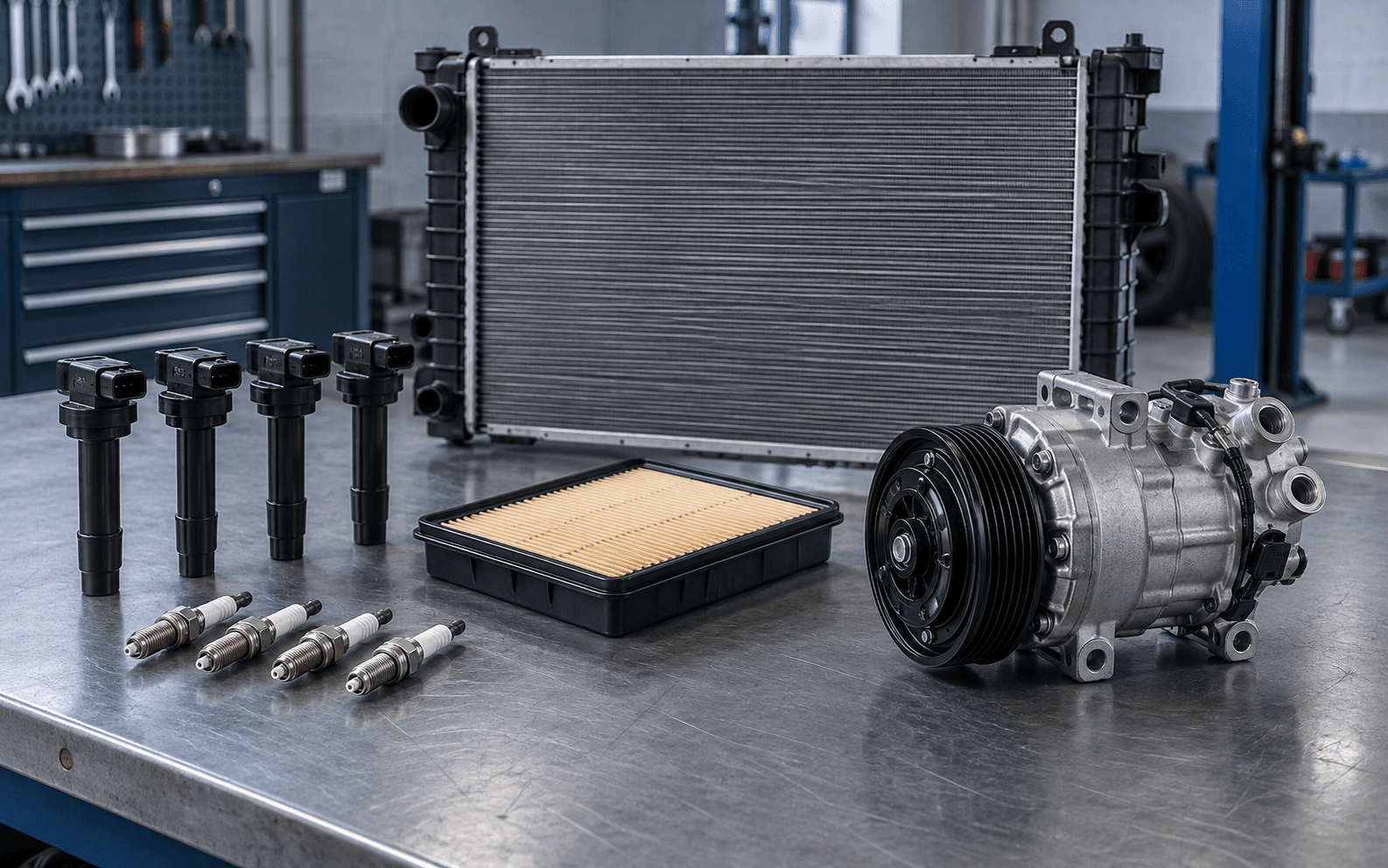
To source BYD DOLPHIN thermal management parts, provide the VIN, exact DOLPHIN model, original market, build date, battery and drive version, OE reference and photos of ports, mounts and connectors. Identify the affected battery, motor, power-electronics or cabin circuit after qualified diagnosis; do not order from a generic cooling symptom.
Short answer: identify the thermal circuit before identifying the part
BYD DOLPHIN thermal management parts should be sourced by exact vehicle and circuit. Provide the VIN, original market, production date, battery and drive version, complete OE reference and clear photographs of ports, mounts, connectors and labels. A qualified technician must identify whether the request concerns the battery, electric drive, power electronics, cabin heat-pump/refrigerant system or another coolant loop.
An EV range complaint, temperature warning, weak cabin heating or cooling, pump noise or coolant loss does not identify one failed component. Several systems and controls interact. The supplier’s task is to match the workshop-confirmed pump, valve, heat exchanger, compressor, hose, sensor or module—not to diagnose the vehicle from a symptom.
This guide is for importers, distributors and service networks preparing a B2B request. It does not provide high-voltage diagnosis, refrigerant work or coolant filling instructions. Those activities require trained personnel, vehicle isolation, appropriate tools, refrigerant recovery and authoritative BYD service information.
Keep DOLPHIN and DOLPHIN SURF as separate vehicle identities
BYD’s regional lineups distinguish DOLPHIN and DOLPHIN SURF. Do not treat SURF as a trim or automatically transfer thermal-system applications between them. Record the exact name, VIN, original sales market and build date before reviewing any reference.
The official BYD DOLPHIN model information describes an integrated EV powertrain and heat-pump-based thermal management for that stated model. The official DOLPHIN owner’s manual contains vehicle and market-specific warnings. These sources explain system context; they are not universal parts catalogues.
Start the commercial enquiry from the BYD DOLPHIN parts page, then use the BYD model ordering guide to keep regional identities visible.

Map the thermal system before creating the RFQ
Use a circuit field for every line. Depending on the exact vehicle, the workshop may identify battery thermal management, drive-motor or power-electronics cooling, cabin refrigerant/heat-pump equipment, gearbox or another component loop. Do not combine these under a generic description such as “Dolphin cooling part.”
For each line record:
- Full VIN and exact regional model designation.
- Original market, destination country and production date.
- Battery, motor/drive and charging-market information where relevant.
- Thermal circuit and installed location.
- Complete OE reference and its source.
- Full part, label, ports, mounts and connector photographs.
- Required assembly boundary and included seals or hardware.
- Quantity, packaging, inspection and documentation needs.
When the vehicle record and OE reference disagree, hold the line. Recheck the number source, model, production break and physical interfaces. The VIN and OE matching guide provides a controlled method.
What common thermal symptoms can—and cannot—tell a buyer
Reduced cabin heating or cooling
Cabin performance can involve refrigerant quantity, compressor, valves, heat exchangers, pumps, sensors, actuators, airflow, filters, software or operating conditions. The purchasing team should not convert “A/C weak” into a compressor order. Request the workshop diagnosis and exact component reference.
Coolant loss
Coolant can escape from hoses, connections, tanks, heat exchangers, pumps, valves or housings and may travel before becoming visible. A stain does not prove the source. Qualified technicians should locate the leak and list the component, seals, clamps and related work required.
Temperature or high-voltage-system warning
A warning may involve several sensors and systems. Follow the vehicle’s warning instructions and use trained EV personnel. Do not advise continued driving to reproduce the condition. A parts supplier cannot clear a fault by guessing a valve or pump from an error description.
Unusual pump, fan or compressor noise
Noise can come from the component, mount, contact, fluid condition, control behavior or another nearby system. A recording can help the workshop but is not a component identity. Source only after diagnosis.
Official coolant guidance reinforces the need for model-specific service data
The official DOLPHIN manual says to use coolant of the same specification as the original, avoid mixing types and allow the system to cool before opening the reservoir. It also recommends qualified service for coolant-related work. These warnings are important because EV thermal circuits can be close to high-voltage components and use model-specific procedures.
BYD’s official regional EV service interval schedule lists coolant-level and other scheduled checks for applicable EVs, including DOLPHIN. The schedule directs users to the respective owner’s manual for detail. Do not publish one market’s interval as universal.
For sourcing, the safe rule is simple: specify the exact vehicle and circuit; use authoritative fluid and service information; never select coolant by color; and do not open a hot or energized system based on general online guidance.
Electric coolant pumps: specify circuit, control and assembly
Identify which circuit the pump serves and whether the request is pump-only, pump with bracket, hose module or a larger valve/pump assembly. Record voltage/system context, hardware reference, connector keying, ports, flow direction marking, mounts and supplied seals.
Two pumps can share an exterior shape and connector family while using different control or performance. A supplier should provide a confirmed application and product-specific function-test basis. A simple motor spin does not establish vehicle-level compatibility.
The quotation must state included brackets, isolators, seals, clips and wiring. At inspection, verify clean capped ports, connector protection, mounts and markings. An electrical function check must follow a defined safe method; do not improvise with an unknown power supply.
Packing should restrain the pump without loading plastic ports. Keep accessory bags separated so metal clips cannot damage housings or connectors.
Coolant valves and integrated manifolds
Thermal valves can route coolant among battery, motor, power electronics and heat exchangers. Record the number of ports, port orientation and diameter, flow markings, connector, actuator/control, bracket and housing. For an integrated manifold, photograph every interface and list all included sensors, pumps or hoses.
Do not approve a valve because the connector and port count match. Internal routing, control and software conditions may differ. Require a controlled OE cross-reference or supplier application evidence and compare the physical interfaces.
At shipment inspection, check housing damage, caps, connector pins, mount, label and accessory content. Functional evidence should name the commanded states or supplier method without implying that a bench test replaces vehicle calibration.
Heat exchangers, radiators, chillers and condensers
Name the component and circuit precisely. A radiator, battery chiller, condenser or cabin heat exchanger has different media, interfaces and controls. Record core and total dimensions, inlet/outlet position, port type, mounts, sensors and supplied valves or seals.
A similar finned unit is not proof of interchangeability. Port geometry and internal design matter. Ask for a drawing or controlled dimensional record and the confirmed vehicle condition. If leakage testing is required, define method, medium, pressure, duration, sample size and acceptance criterion with competent technical personnel.
Packing should protect fins, necks, sealing faces and ports. Use clean caps and rigid supports that do not compress the core. During shipment inspection, photograph identity, fins, mounts, ports, caps and carton support.
For refrigerant-side components, recovery and charging require trained personnel and local compliance. The U.S. EPA motor-vehicle air-conditioning guidance is one official example; destination-market rules control the actual service.
Electric compressor sourcing
An EV compressor request needs the exact vehicle, original market, hardware/OE reference, high-voltage/system context, refrigerant circuit, ports, mounts, low-voltage control connector and supplied oil/seals only where verified. State whether the quotation covers compressor-only or a module.
Connector and bolt pattern do not prove compatibility. Electrical characteristics, control communication, refrigerant/oil requirements and software conditions may differ. Ask the supplier to state new/remanufactured status, application and test method accurately.
Do not energize or open a high-voltage compressor during general receiving inspection. Qualified suppliers may provide product-specific electrical and leakage records. Warehouse checks should focus on identity, ports/caps, connector condition, mounts, visible damage, accessories and packing.
Transport and handling instructions should protect high-voltage and refrigerant interfaces. If the product faces dangerous-goods or shipping controls, confirm the actual classification with a competent logistics specialist rather than assuming all EV parts are regulated alike.
Share the reference, vehicle application and target quantity so the technical and packing questions can be reviewed against your actual order.
Upload Your RFQHoses, pipes, reservoirs and connectors
For coolant hoses, capture the full molded route, branch points, internal diameters, quick-connect ends, clamps, protective sleeves and flow/position markings. A generic hose cut to length is not equivalent to a molded EV thermal assembly unless authoritative service information permits it.
Rigid pipes and integrated hose sets need bend geometry, mounts, seals, valve or sensor provision and corrosion/finish requirements. Long pieces require shape-retaining packing. Quick connectors must be protected from damage and contamination.
For a reservoir, compare shape, mount, hose connections, sensor, cap and level markings. The cap is a functional part; use the exact reference and do not copy a pressure rating from another model. State cap-included or cap-excluded clearly.
Sensors, control modules and wiring
Temperature, pressure and position sensors require exact installed location, OE/hardware number, mount/thread or seal, connector and system function. “DOLPHIN temperature sensor” is too broad. The vehicle may use several inputs across different thermal circuits.
A diagnostic code does not necessarily prove sensor failure. The workshop must diagnose wiring, supply, system condition and related data. Once confirmed, the RFQ should keep the circuit and connector evidence visible.
Modules and controlled valves may depend on software, coding or calibration. Confirm requirements from authoritative service data. A supplier should not promise plug-and-play operation from a housing and connector match.
For wiring or harness sections, record routing, branch points, clips, sealing, connector keying and high-/low-voltage classification. High-voltage orange components require trained handling and exact identification.
Heat pump versus conventional A/C descriptions
BYD’s model information describes heat-pump thermal management for DOLPHIN in the referenced market. Buyers still need to confirm the exact regional vehicle and component. Do not use a general “heat pump part” label for compressor, valve, exchanger, pump or sensor.
Build the RFQ around the service item and circuit. The supplier should return its part number, exact model/production condition, assembly content and exclusions. This makes quotations comparable and prevents a conventional A/C component from being confused with a broader integrated thermal module.
For cabin complaints, also separate airflow parts such as blower, filter, actuator and heater components from refrigerant or coolant parts. Diagnosis should identify which system needs repair.
A seven-step DOLPHIN thermal-parts workflow
Step 1: obtain a qualified diagnosis
Record symptom, diagnostic findings, circuit and confirmed replacement list separately. High-voltage and refrigerant work must be performed by trained personnel.
Step 2: validate the vehicle
Confirm DOLPHIN—not DOLPHIN SURF—plus VIN, market, build date, battery and drive configuration.
Step 3: identify the circuit
State battery, motor/power electronics, cabin refrigerant/heat pump or another confirmed loop.
Step 4: capture OE and interface evidence
Preserve the complete number and source. Photograph ports, mounts, connectors, labels and installed position.
Step 5: define assembly content
List pump, valve, bracket, sensor, controller, seals, hoses, caps and hardware included or excluded.
Step 6: approve product and test basis
Record the supplier number, application, drawing/sample, product-specific checks, packaging and change-control expectation.
Step 7: inspect and release shipment
Verify identity, clean protected interfaces, accessories, quantity, labels, cartons and required lot records.
Factory testing: separate function from fitment
Ask what characteristic was tested, by which method, on what sample size and against which criterion. A heat exchanger may have defined dimensional, cleanliness and leakage controls. A pump or valve may have electrical and functional checks. A compressor may have supplier-specific electrical, pressure or leakage evidence.
Fitment evidence remains separate. A part can pass its manufacturing test but use the wrong port, mount, control or application. The approval plan must contain both the vehicle/circuit match and the production controls.
Do not request irrelevant documents simply to make the file larger. Define the risk and decisive characteristics first, then request evidence that supports them. The supplier audit checklist can trace one product from RFQ through shipment.
Copy-ready BYD DOLPHIN thermal RFQ
- Buyer SKU / line:
- VIN / exact model / original market / build date:
- Battery and drive version:
- Qualified diagnosis and thermal circuit:
- Required component and installed position:
- Complete OE reference and source:
- Ports, mounts, connectors and controlled dimensions:
- Included seals, bracket, controller, hoses or hardware:
- Quantity / packaging / destination:
- Required sample, test and inspection evidence:
- Open technical questions:
Ask the supplier to return its number, confirmed model/circuit condition, exclusions, assembly content, drawing/sample availability, test basis, MOQ, lead-time assumptions and packing. The automotive RFQ guide supports mixed-SKU enquiries.
Common purchasing errors
- Treating DOLPHIN and DOLPHIN SURF as one application.
- Ordering from “cooling problem” without a diagnosed circuit.
- Matching a pump, valve or compressor by connector alone.
- Comparing component-only and complete-module quotations.
- Omitting battery/drive, market or production date.
- Mixing coolant types or specifications from another market.
- Treating cabin airflow, refrigerant and battery cooling as one system.
- Accepting “100% tested” without a named method and criterion.
- Shipping heat exchangers with uncapped ports or unsupported fins.
- Substituting a software-dependent component without review.
FAQ
What information is required for BYD DOLPHIN thermal management parts?
Send the VIN, exact DOLPHIN model, original market, build date, battery/drive version, diagnosed thermal circuit, complete OE reference, ports, mounts, connectors, assembly scope, quantity and destination requirements.
Can DOLPHIN coolant be selected by color?
No. Use the specification and procedure in authoritative information for the exact vehicle and market. The official manual warns against mixing different coolant types and opening a system before it has cooled.
Does weak cabin heating prove the heat pump is faulty?
No. Refrigerant, coolant, airflow, compressor, valves, sensors, controls and operating conditions can contribute. Qualified diagnosis should identify the affected system and component before sourcing.
Can a DOLPHIN electric pump be tested with a battery supply?
Do not energize an unknown controlled component using an improvised setup. The supplier’s test should use a defined safe method, while warehouse inspection focuses on identity and physical condition.
What should be inspected before shipment?
Verify product and carton identity, model/circuit condition, markings, ports and caps, mounts, connector, fins or sealing faces, included accessories, quantity, protective packing and required lot records.
Conclusion: make the thermal circuit part of the product identity
Reliable BYD DOLPHIN thermal management parts sourcing connects a qualified diagnosis to an exact vehicle, circuit, OE reference and physical/control interfaces. Keep DOLPHIN and SURF separate, define the assembly, approve product-specific evidence and protect clean interfaces through shipment inspection.
PartDorin is an independent B2B sourcing and manufacturing-support company and is not affiliated with or authorized by BYD. To prepare a DOLPHIN thermal order, send your VIN, diagnosed circuit, OE references, photos and quantities. We can organize confirmed lines and open questions for a controlled quotation.
Discuss the requirements for your next order.
Send your part references, vehicle applications, target quantities, destination market and any inspection or packing priorities. PartDorin will review the information needed for a focused quotation.
Send Your Requirements