 PartDorinUpload RFQRFQ
BYD ATTO 3 brake parts sourcing: pads, discs, calipers and VIN checks
Turn a brake symptom or workshop list into a controlled ATTO 3 parts request without treating noise, wear or appearance as a remote diagnosis.
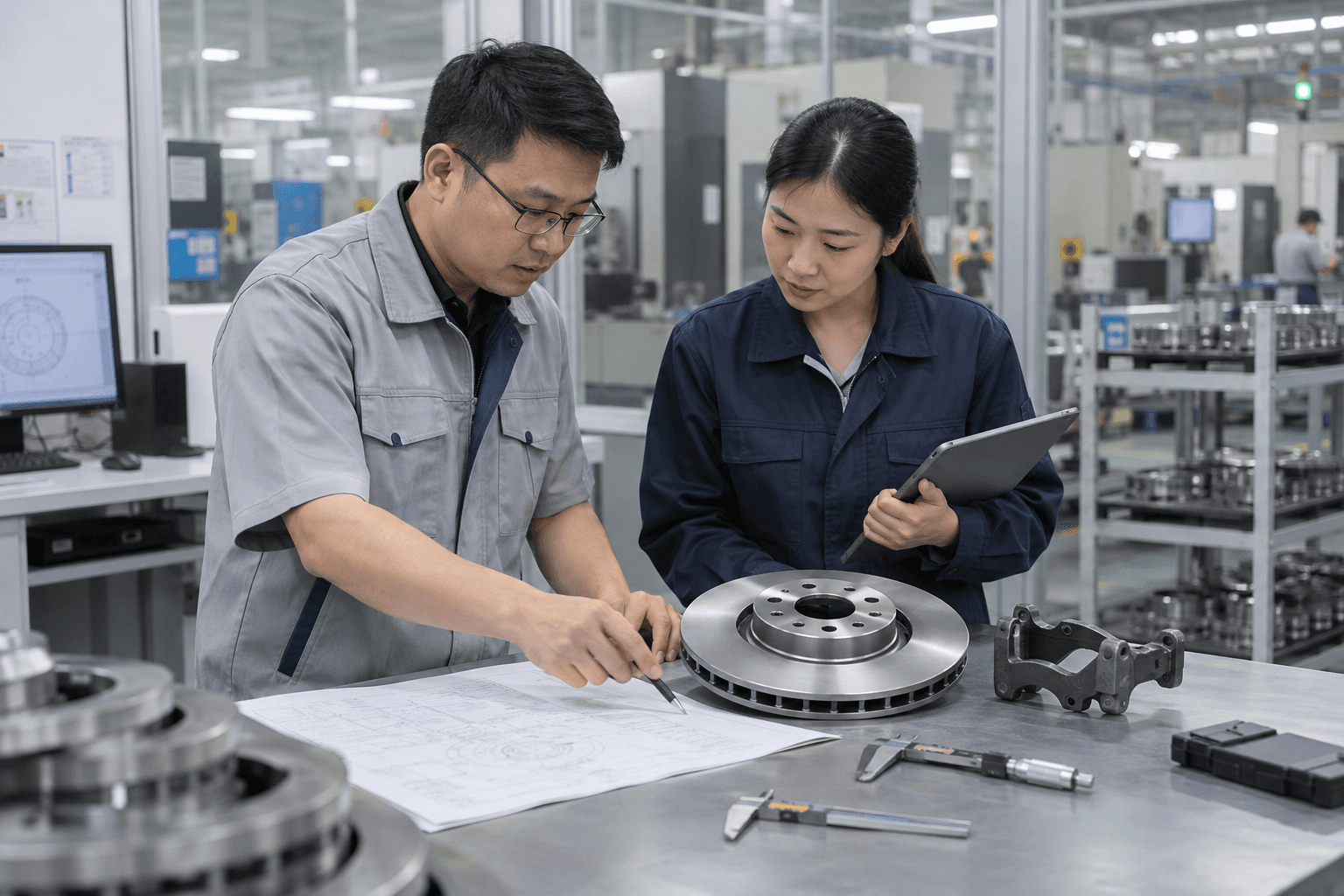
To source BYD ATTO 3 brake parts, provide the VIN, original market, build date, axle and side, complete OE reference, brake-package details and clear photos. Separate brake pads, discs, calipers, hoses and electronic parking-brake scope. A noise or warning can guide inspection, but a qualified technician must identify the required repair.
Short answer: diagnose first, then source by VIN and brake configuration
BYD ATTO 3 brake parts should be sourced from a workshop-confirmed repair list, not from a noise description alone. Provide the 17-character VIN, original sales market, production date, axle and side, brake-package details, complete OE reference and photographs of the removed component. Then define whether the request covers pads, discs, calipers, carriers, hoses, sensors, hardware or electronic parking-brake parts.
This distinction protects both safety and purchasing accuracy. Brake noise, vibration, a dashboard warning or visible surface corrosion can have more than one cause. The same observation does not automatically mean that pads and discs must be replaced. A qualified technician should inspect the vehicle and specify the required repair before a distributor or supplier builds the parts list.
This guide is for importers, distributors and repair networks preparing a B2B ATTO 3 brake order. It does not provide a vehicle repair procedure. Installation, hydraulic bleeding, fastener torque, electronic service modes and post-repair checks must follow authoritative BYD information and local requirements.
What belongs in an ATTO 3 brake-parts RFQ
One RFQ row should identify one sellable item or defined kit. Include:
- Complete VIN and a permitted photograph of the VIN source.
- Exact model designation, original market and destination country.
- Physical production month or date.
- Axle and left/right position where relevant.
- Wheel, brake or drive configuration known from the vehicle record.
- Complete OE number and whether it came from the removed part, service data or another source.
- Overall, label, mounting and interface photographs.
- Required assembly boundary and included hardware.
- Quantity, packaging, labeling and inspection requirements.
The ATTO 3 vehicle-parts page provides the broader model identity fields. Use the VIN and OE matching workflow when the number and vehicle data do not immediately agree.
The VIN anchors the request to one vehicle, but it is not a substitute for part-level evidence. The NHTSA VIN Decoder explains the role of the standardized 17-character identifier. A public decoder may reveal useful vehicle attributes, but it does not necessarily expose the exact service brake configuration for every market.
How to interpret brake symptoms without turning them into a parts diagnosis
Brake noise
Squeal, scraping, clicking or grinding describes a sound, not a confirmed failed component. A workshop may inspect friction-material condition, disc surface, foreign material, hardware, caliper movement, shields, wheel-end condition and installation history. The purchasing team should wait for that diagnosis and request the component evidence used to create the parts list.
Do not publish a claim that brake noise is a “common ATTO 3 failure” without reliable population-level evidence. Individual posts and workshop enquiries can reveal search language, but they cannot establish a failure rate. For B2B content, the trustworthy answer is that noise requires inspection and that the resulting parts order must be matched to the exact vehicle.
Pedal pulsation or steering vibration
Vibration under braking can involve the brake system, wheel mounting or other chassis conditions. The supplier cannot diagnose it from an email. If a technician specifies discs, the RFQ should include the axle, OE reference and the dimensions that decide the application. A measurement or diagnostic conclusion should come from qualified personnel using an appropriate method.
Warning messages or electronic parking-brake concerns
A warning can relate to sensors, wiring, control logic, hydraulic or parking-brake components. A connector photograph is not enough to approve an electronic part. Record diagnostic information for the workshop, but provide suppliers only the data needed for the commercial and technical comparison. Coding, calibration or service-mode requirements must be checked in authoritative information.
Visible rust or wear
Appearance alone does not define serviceability. A technician should compare the actual condition with the vehicle manufacturer’s limits and local inspection rules. The sourcing team should not invent a universal discard thickness or pad-wear threshold. When a disc is approved for replacement, record the correct reference and new-product dimensions required for receiving inspection rather than using an unsupported in-service limit.
ATTO 3 maintenance information is market-specific
Official maintenance documents demonstrate why buyers should record the original market. BYD’s European/Cyprus EV service interval schedule lists brake pads, discs, hoses, lines, fluid and suspension as scheduled inspection items for applicable EV models including ATTO 3. The schedule also states that detailed maintenance should follow the respective owner’s manual.
The official 2024 ATTO 3 right-hand-drive owner’s manual includes market-specific service information. Another region can use different intervals or wording. Therefore, a distributor should not copy an interval from one manual into a universal product claim.
For parts sourcing, maintenance schedules are evidence that the system is inspected; they do not prove which product a particular vehicle requires. The workshop diagnosis and VIN-specific part record remain decisive.
Brake pads: the information needed before quotation
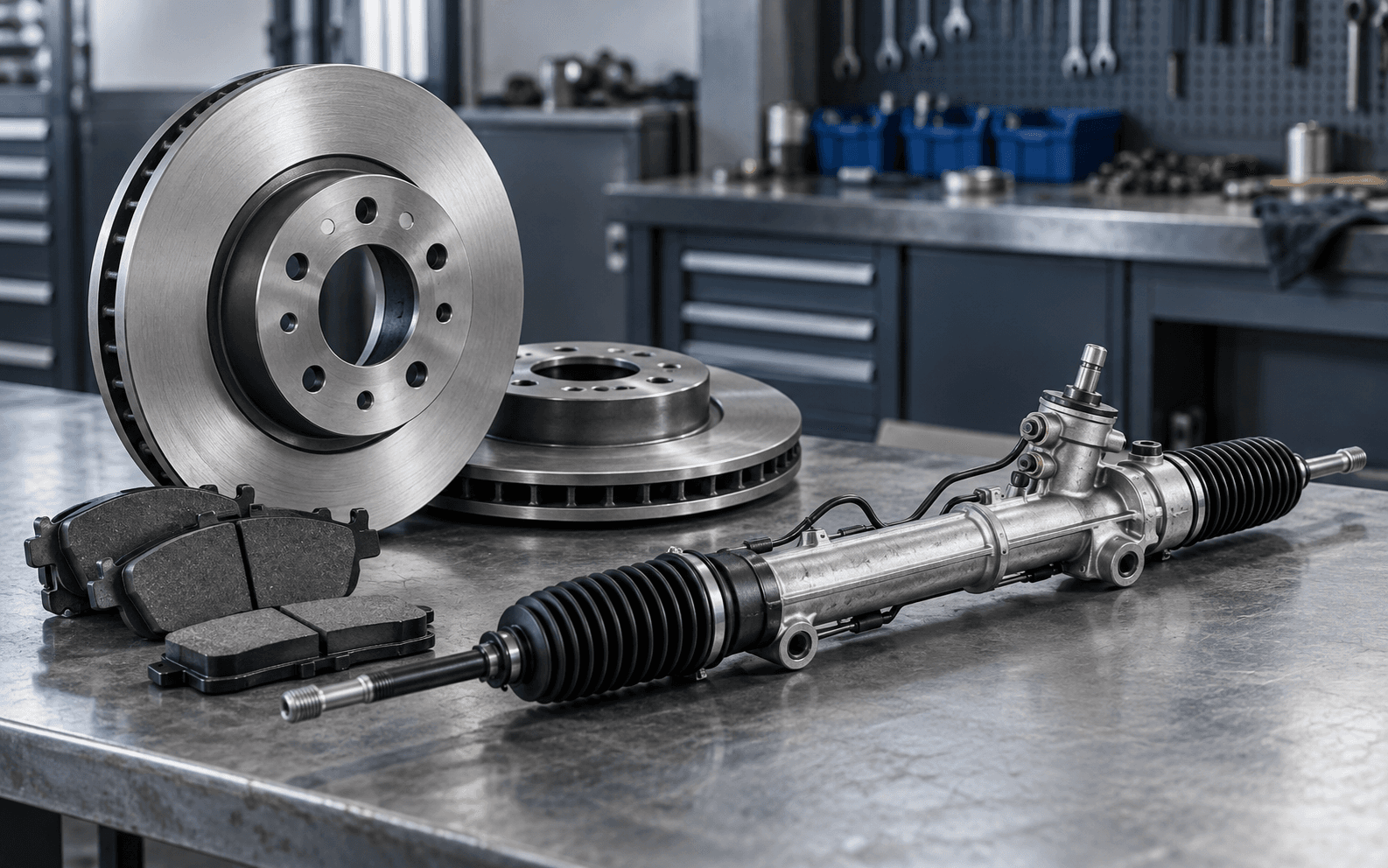
Identify front or rear axle and the applicable caliper or brake package. Provide the complete OE reference, a straight-on photograph of the backing plate, overall pad dimensions where available, sensor or wear-indicator arrangement, shims, clips and any supplied hardware. State whether the commercial unit is one pad, one wheel set or one axle set.
Pad outline is an important interface, but it is not the entire specification. Friction material, backing plate, attachment, compressibility, marking, test evidence and destination-market requirements also matter. Buyers should define their quality and regulatory position instead of approving from shape alone.
If the product is sold in a market applying replacement brake-lining regulation, confirm the current legal and documentation requirements with a competent specialist. The UNECE transport regulations portal is an authoritative starting point, but the buyer must determine which rules apply to the exact product and destination.
Compare quotations by included content. One offer may include shims and clips; another may quote friction pads only. Put the approved accessory list on the purchase order and inner label so it can be checked during packing.
Brake discs: dimensions, construction and packing
A useful ATTO 3 brake-disc record includes axle, OE reference, outside diameter, nominal thickness, overall height, center bore, bolt pattern, ventilation or solid construction, surface/coating condition and any relevant parking-brake interface. The decisive dimensions should come from a controlled drawing, approved sample or competent measurement, not an angled photograph beside a ruler.
Diameter alone does not establish fitment. A disc with the correct outside diameter can still have the wrong height, bore, bolt pattern or thickness. Request that the supplier return its drawing or measured reference against the buyer’s baseline and state any exclusion.
Heavy discs need individual protection and suitable cartons. Agree corrosion protection, separators, edge protection, carton quantity and pallet plan. During shipment inspection, check that machined faces are protected without contamination, labels identify the correct axle/reference, and cartons remain stable under handling.
Do not state an in-service minimum thickness unless it comes from authoritative information for the exact vehicle. The distributor’s incoming inspection normally verifies the new product against the approved product specification; it is not the workshop’s discard-limit inspection.
Calipers, carriers and electronic parking-brake scope
For a caliper request, record axle, left/right side, caliper body, piston configuration, mounting, hydraulic hose port, bleed-screw orientation and whether the carrier is included. State whether pins, boots, clips, pads or mounting hardware are part of the sellable unit. A price comparison is invalid if one offer includes the carrier and another does not.
Rear brake assemblies may interact with an electronic parking-brake system. Identify whether the request is for a mechanical caliper, an actuator, a complete assembly or another component. Record connector and hardware references and ask whether any service mode, coding or initialization applies. Do not promise plug-and-play replacement from a housing match.
Remanufactured products require an explicit scope. The quotation should say whether the unit is new or remanufactured, which parts are renewed, how the core is controlled, what pressure or movement checks are performed, and how cleanliness and corrosion protection are managed. Do not describe a remanufactured caliper as new.
At inspection, check side identity, boots, threads, ports, caps, bleed interface, actuator/connector condition and included hardware. Protect all openings against contamination.
Front versus rear: keep position in every identifier
Front and rear pads, discs and calipers serve different applications and must have separate buyer SKUs. Left and right calipers or hoses should also remain separate where orientation differs. Put the position in the product description, warehouse label and inspection sheet rather than relying on staff to recognize the component.
If a supplier proposes one pad family for more than one axle or market, ask for the underlying application evidence. The relationship can be valid, but the buyer should preserve each vehicle/axle condition in its catalogue. This makes later production changes and returns easier to investigate.
For a mixed shipment, use carton marks that show buyer SKU, product name, axle/side, quantity and controlled cross-reference. Avoid ambiguous labels such as “ATTO brakes.” The quality-control inspection checklist explains how to connect those identifiers to lot release.
A seven-step ATTO 3 brake-parts sourcing workflow
Step 1: obtain a qualified repair list
Ask the workshop to identify the components required and any related service work. Keep symptoms and diagnostic conclusions in separate fields.
Step 2: validate the vehicle
Check VIN, model, original market and production date. If the VIN and registration information conflict, resolve the vehicle record before searching parts.
Step 3: capture the OE evidence
Photograph the removed part and label where practical. Preserve suffixes and state whether the reference identifies a complete assembly or subcomponent.
Step 4: define position and assembly scope
Record axle, side and what is included. Separate pads, discs, calipers, carriers, actuators, hoses and hardware into clear quotation rows.
Step 5: compare decisive interfaces
Use product-specific geometry, mounts, ports, connectors and controlled drawings. Mark unresolved differences instead of choosing by appearance.
Step 6: approve the product baseline
Define the sample, dimensional, functional, regulatory and packaging evidence appropriate to the line. Record who approved it and for which vehicle condition.
Step 7: carry identity into shipment inspection
Verify product marking, side/axle, accessories, quantity, label and protective packaging against the purchase order. Photograph the selected product and its carton together.
Factory testing: ask what was actually tested
The phrase “factory tested” is incomplete unless the supplier names the characteristic, method, sample size and acceptance criterion. For a caliper, a relevant plan may address pressure integrity, leakage and movement. For a disc, it may address defined dimensions, material or runout controls. For a pad, it may address geometry, material and required product/market evidence.
A bench test does not prove every vehicle application. Keep fitment evidence separate from manufacturing test evidence. The first answers “is this the right configuration?” and the second answers “does the produced item meet the approved specification?” Both are necessary for a controlled sourcing program.
When reviewing a supplier, follow one line from RFQ through drawing or sample approval, production control, final inspection and packing. The automotive supplier-audit checklist provides a practical framework.
Sample approval and installation feedback
Record the sample’s supplier number, OE cross-reference, vehicle condition, dimensions or features checked, markings and accessory content. If a qualified workshop installs it, record the exact VIN/configuration and the scope of the check. Do not extend one installation result to every ATTO 3 market and production date.
After the first shipment, classify feedback. A wrong-part report can result from incorrect vehicle identity, cross-reference, production change, supplier substitution, warehouse picking or installation. Retain the product and carton labels and compare them with the approved record before changing catalogue data.
If the supplier changes its product number, source, drawing, hardware or packaging, require a change notice. Decide whether documents, a sample or installation verification must be repeated.
RFQ template for ATTO 3 brake parts
Use this copy-ready block:
- Buyer SKU and RFQ line:
- VIN / build date / original market:
- Front or rear / left or right:
- Brake package or relevant vehicle option:
- OE number and source:
- Required part and assembly boundary:
- Included sensor, clips, shims, carrier, actuator or hardware:
- Key dimensions or drawing attached:
- Quantity / selling unit / packaging:
- Destination market and required evidence:
- Open technical questions:
Ask the supplier to return the supplier number, confirmed vehicle/axle condition, exclusions, included content, sample or drawing availability, inspection basis, MOQ, lead-time assumptions and packing. The automotive parts RFQ template can support a larger multi-SKU list.
Common purchasing errors
- Ordering from “ATTO 3 + model year” without VIN, market and build date.
- Treating brake noise as proof that pads and discs both need replacement.
- Omitting front/rear or left/right position.
- Approving pads from backing-plate shape alone.
- Checking only disc diameter and ignoring height, bore and thickness.
- Comparing caliper prices without confirming carrier, actuator and hardware.
- Treating an electronic connector match as proof of compatibility.
- Using “factory tested” without a method and acceptance criterion.
- Packing heavy discs in cartons not designed for the load.
- Relabeling a substitute without technical review and change control.
FAQ
Can all BYD ATTO 3 brake pads use one reference?
Do not assume so. Confirm the VIN, market, production date, axle, brake package and OE reference. If one product covers several conditions, retain the supplier’s supporting application evidence and list the approved scope precisely.
Does regenerative braking change the parts-matching process?
The vehicle’s braking strategy does not remove the need to identify friction-brake components accurately. Pads, discs, calipers and hydraulic parts still require axle, geometry, OE and market evidence. Diagnosis and service procedures must follow authoritative information.
Should pads and discs always be replaced together?
That decision belongs to the qualified workshop after inspection and comparison with applicable service information. The sourcing team should quote the confirmed repair list and avoid turning a general sales recommendation into a universal technical rule.
Can an ATTO 3 brake disc be approved from an OE number only?
Use the complete OE number as a strong reference, then check axle, vehicle condition, drawing or key dimensions, construction and supplier evidence. This protects against copied, shortened or condition-dependent cross-references.
What should be checked before the shipment leaves China?
Verify part and carton identity, front/rear and left/right position, markings, dimensions or interfaces in the inspection plan, included hardware, corrosion protection, quantity and carton/pallet condition.
Conclusion: make the diagnosis and part identity traceable
Reliable BYD ATTO 3 brake parts sourcing begins after a qualified diagnosis. Build the order from VIN, market, production date, axle, OE evidence and product-specific interfaces. Define the assembly boundary, approve a controlled baseline, and carry the same identity through labels and shipment inspection.
PartDorin is an independent B2B sourcing and manufacturing-support company and is not affiliated with or authorized by BYD. To prepare a distributor order, send your ATTO 3 VINs, OE references, workshop list and quantities. We can organize confirmed lines, missing evidence, packaging and inspection requirements for a focused quotation.
Discuss the requirements for your next order.
Send your part references, vehicle applications, target quantities, destination market and any inspection or packing priorities. PartDorin will review the information needed for a focused quotation.
Send Your Requirements